
Calm · Neutral · Child-Focused
A structured, neutral environment where difficult family decisions are reached through open and respectful dialogue — outside the courtroom, on terms that actually fit everyday life.

When relationships change through separation, divorce, or shifts in living arrangements, the impact reaches far beyond legal paperwork. The choices made about children, daily routines, finances, and shared responsibilities shape everyday life for years to come.
Family Mediation creates a structured, neutral environment where those decisions can be discussed openly and respectfully. Rather than positioning people against each other, the process focuses on cooperation, understanding, and practical problem-solving — guided by an impartial professional whose sole purpose is to help your family move forward.
At its heart, Family Mediation is about giving families control over their own outcomes. Instead of handing decisions to a court, participants work together with a trained mediator who guides conversation and keeps it balanced. The mediator does not take sides or impose solutions.
Their role is to ensure that each person has the opportunity to speak, that discussions remain productive, and that the needs of any children involved remain central. This approach is particularly valuable for parents, grandparents, blended families, and extended relatives who want clarity and stability without escalating conflict.
The process typically begins with an initial meeting to understand the issues and confirm that mediation is appropriate. Structured sessions then explore key topics such as living arrangements, schooling, communication methods, financial contributions, and long-term planning.

Conflict can quickly intensify when communication breaks down, particularly during separation. Professional mediation provides the structure and impartiality that private conversations cannot. It encourages calm dialogue, helps individuals feel heard, and consistently produces more sustainable outcomes than adversarial alternatives.
Mediation encourages calm dialogue and helps individuals feel genuinely heard. This improves co-parenting relationships and supports healthier communication over time — reducing the emotional toll that prolonged dispute inevitably creates.
Because agreements are shaped by the people involved, they tend to be more realistic and sustainable than court-imposed decisions. Families are more likely to honour what they have designed themselves, reducing the likelihood of future conflict.
When parents are able to cooperate and present consistent arrangements, children feel more secure and less caught in the middle. The stability mediation creates benefits children long after the formal process has concluded.

The process follows a clear, structured path — from the first confidential conversation through to a written agreement that reflects the real priorities of your family. Each stage is designed to move at a pace that is manageable, and to keep discussion focused on what is most important.
A private, confidential meeting to understand the situation, confirm suitability, verify basic facts, and identify any immediate needs. The mediator explains confidentiality, neutrality, and voluntary participation.
Participants receive a clear outline of what to expect and are invited to bring relevant documents — school timetables, daily routine summaries, childcare details — to give practical clarity from the outset.
Joint or separate sessions explore key topics: living arrangements, schooling, communication, financial contributions, and long-term planning. Sessions typically last 60 to 90 minutes and move at the family's pace.
Decisions are converted into clear, specific written agreements covering handovers, routines, communication, school arrangements, and financial responsibilities. Review sessions are available when circumstances change.
Family Mediation is suited to anyone who would rather shape outcomes themselves than hand decisions to courts or adversarial lawyers. It works across a wide spectrum of family situations, wherever practical conversation and cooperative decision-making are possible.
Parents who are separating often choose mediation to create child-centred parenting plans that fit the realities of school, work, and family life. Rather than debating principles in court, mediation maps out practical schedules, communication methods, and handover arrangements that reduce disruption for children.
Blended families face complex dynamics. Mediation helps step-parents, biological parents, and children agree on roles, holiday patterns, and school logistics in ways that protect relationships and limit confusion — creating a foundation of shared understanding.
Grandparents or other extended family members seeking clarity about visiting, childcare involvement, or guardianship can use mediation to reach respectful, workable agreements that acknowledge everyone's position without adversarial confrontation.
Families caring for older relatives, or those with children who have disabilities or complex medical needs, often find mediation invaluable. It supports the creation of detailed, consistent plans covering medical appointments, education supports, specialist transport, and day-to-day care routines.
Family Mediation covers many situations beyond simple parental separation. Whether the challenge involves a shift in living arrangements, a dispute within a blended family, or the management of care for a family member with changing needs, mediation provides a structured path toward workable solutions.
The process is particularly effective where communication can be rebuilt or supported, where keeping children's welfare front and centre is a priority, and where privacy and speed matter more than a precedent-setting legal ruling. Even when emotions are strong, structured sessions break large problems into smaller, manageable steps.
For complex situations involving different jurisdictions, international travel, or specialist care arrangements, mediation provides a practical framework that can be complemented by independent specialist advice where needed.
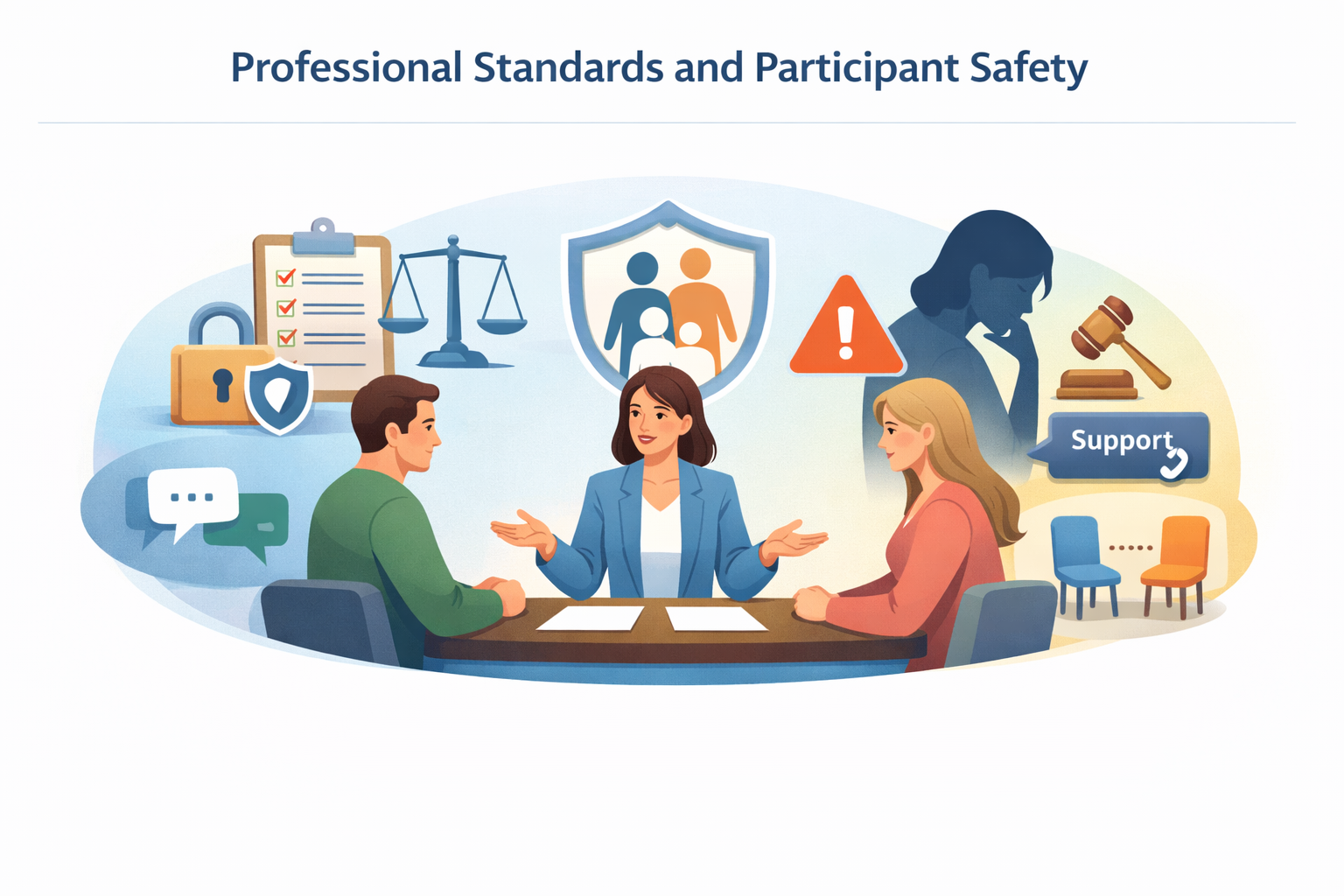
There is no single model for how mediation must take place. Different situations call for different approaches, and the process is adapted to ensure all participants feel comfortable, safe, and able to engage constructively with the issues at hand.
Outcomes in Family Mediation are practical and tailored to real life — not abstract principles or legal precedents. Agreements reflect the actual rhythms of school, work, and family routines, and are built to function from the first day they are implemented.
"Mediation is not about winning or losing. It is about reaching balanced decisions that respect everyone involved while prioritising the wellbeing of children."— Core Principle of Family Mediation
Family Mediation is conducted within a clear professional and ethical framework. Mediator neutrality, participant safety, and the integrity of the process are non-negotiable. Where safety concerns exist, the process is adapted accordingly — and where mediation is not appropriate, the mediator will say so clearly and direct participants toward the right support.
Confidentiality is a core feature of Family Mediation and creates a protected space for open discussion. Mediators explain the limits of confidentiality at the outset — for instance, where there is an immediate risk of harm or when disclosure is required by law. Within those limits, conversations remain private and are not used as evidence in court without agreement.
Where there are allegations of domestic abuse, mediators assess risk carefully. In some cases, mediation can continue with adaptations such as separate sessions or with specialist support in place. When there is ongoing risk or coercive control, the mediator will recommend specialist legal and safety resources instead of joint mediation.

A written agreement is the beginning, not the end. Family circumstances evolve — children grow, work patterns shift, and new situations arise. Family Mediation builds flexibility and review into the process itself, so arrangements can adapt without returning to conflict.
Many parenting plans include scheduled review points to reflect children's changing needs or new circumstances. Mediation is flexible and can be used to make adjustments without returning to an adversarial process.
Plans include built-in steps for resolving minor issues without returning to formal proceedings. This provides a clear first recourse when small disagreements arise, keeping communication structured and productive.
Agreements can be recorded as plain-language parenting plans or more formal memoranda of understanding. Where a legally binding outcome is desired, parties may seek independent legal advice and convert the agreement into a consent order through the appropriate legal route.
Mediation itself is not a court order. Agreements reached through mediation can be recorded in writing and, if desired, converted into a legally recognised consent order through the appropriate legal route. Family Mediation provides the content and clarity — formal legal steps remain optional.
If one person declines to participate, mediation can still assist the person who wishes to engage by clarifying priorities and preparing proposals. Shuttle mediation may also be used to convey offers between parties. If attendance is not possible, the mediator will explain alternative pathways.
Yes. Confidentiality is a core feature of Family Mediation and creates a protected space for open discussion. Mediators explain the limits of confidentiality at the outset. Within those limits, conversations remain private and cannot be used as evidence in court without agreement.
Independent legal advice may be sought at any stage. Mediators do not provide legal representation but can explain general legal concepts and indicate when independent advice would be beneficial. Many people arrange for a solicitor to review a written agreement before finalising it.
If a full agreement cannot be reached, mediation still clarifies each party's position and narrows the issues — which can make other processes, including court, quicker and clearer. The mediator will outline next steps and signpost legal or specialist options where appropriate.
Family Mediation can proceed only where it is safe to do so. Mediators assess risk carefully when allegations of domestic abuse are present. Where separate sessions or specialist support can make mediation safe, that approach may be used. Where ongoing risk or coercive control exists, specialist resources are recommended instead.
There is no fixed number of sessions. Many families make substantial progress in a few meetings; others require more time to resolve complex arrangements. Sessions typically last 60 to 90 minutes, and the pace is set entirely by the family's needs.
Yes. Family Mediation can include extended family members when their involvement is relevant and helpful. The mediator ensures the agenda remains focused on constructive decision-making and that children's needs stay central throughout.
Absolutely. Mediators work with families to create detailed, specific plans that account for medical appointments, therapy schedules, specialist transport, and consistent routines. The aim is to reduce disruption and ensure all caregivers share a clear understanding of their responsibilities.
Agreements can be revisited. Many parenting plans include review points to reflect children's changing needs or new circumstances. Mediation remains available to make adjustments without returning to an adversarial process.
Working through the process helped us create a parenting plan that actually fits our week. The mediator kept the conversation focused on what our children needed rather than on the things we disagreed about.
The sessions were practical and calm. We reached clear arrangements without prolonged conflict and were able to put routines in place for the children quickly, without the uncertainty of waiting for a court date.
Mediation helped us clarify visiting arrangements and school pickups in a way that respected everyone's schedules and removed the tension that had built up around those conversations. It was a far better outcome than we expected.
We found realistic ways to share holidays and responsibilities between two households. The agreement reduced tension and made family life more predictable and secure for the children — which was the only thing that really mattered.
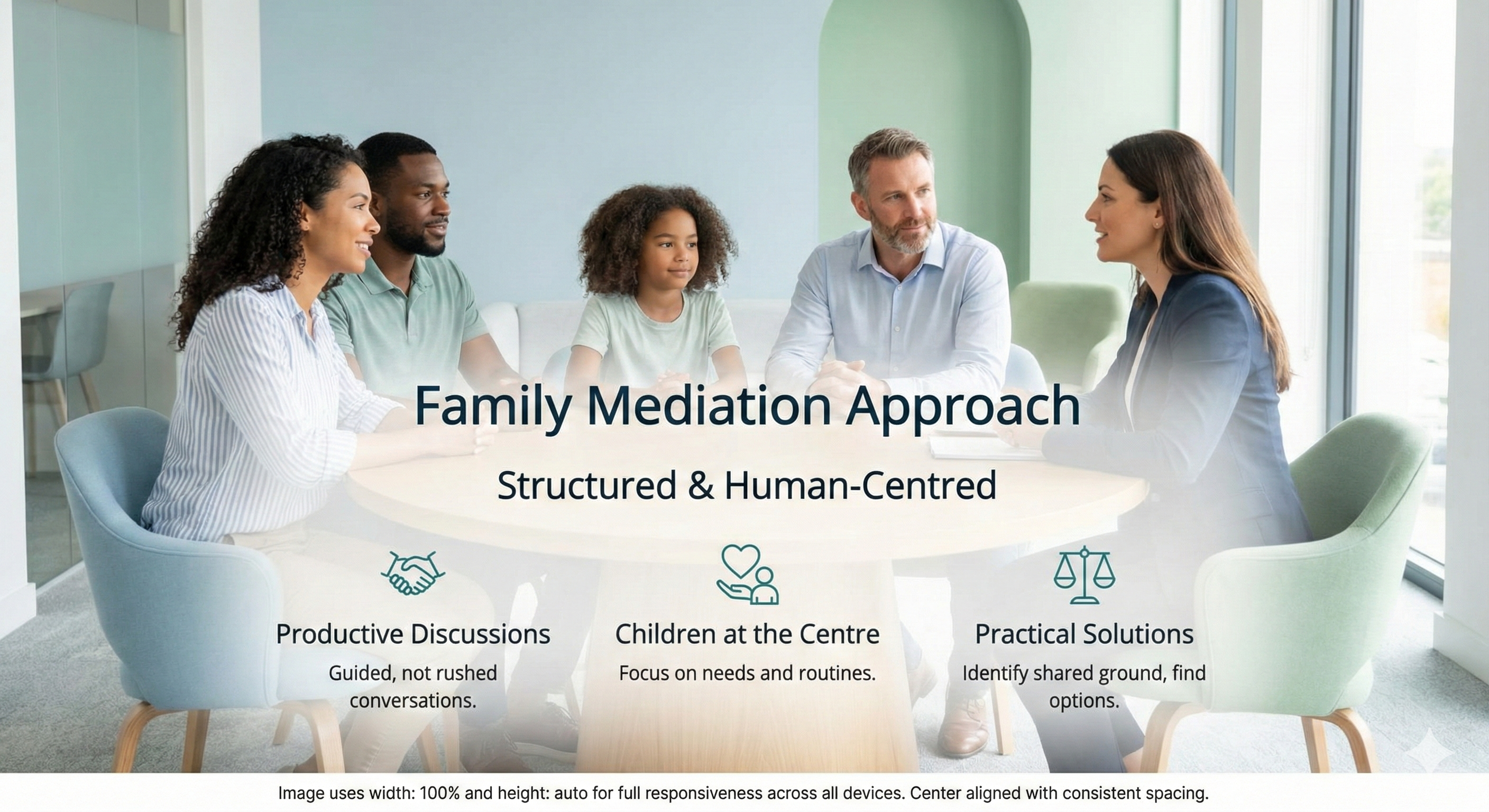
Every family situation is different, and the mediation process reflects that. The approach is structured enough to keep discussions productive and moving forward, and flexible enough to accommodate the complexity of real family life. The mediator's role is not to judge or advise — but to listen carefully, identify areas of shared ground, and help translate concerns into workable options.
Conversations are guided, not rushed. Space is given to emotions while steadily moving toward practical solutions. Children's needs and routines remain at the centre of every stage — from the first intake conversation through to the final written agreement.
Where the process surfaces legal or financial questions beyond the mediator's role, participants are encouraged to seek independent specialist advice. The mediator can signpost appropriate services and incorporate that guidance into the discussion.
The first mediation meeting is designed to be reassuring and practical. There is no pressure to reach immediate decisions. The goal of the initial conversation is simply to understand the situation, confirm that mediation is appropriate, and agree on a clear plan for the sessions ahead.
Before your first meeting, consider your immediate priorities: school pickups, upcoming holidays, childcare arrangements, or short-term financial needs. Having a clear sense of what matters most will help the initial session focus quickly on the most pressing issues.
Bring documents that clarify the practical picture — school calendars, any professional reports relevant to children's care, notes about daily routines, childcare details, or summaries of current arrangements. The aim is practical clarity, not exhaustive formal disclosure.
The mediator will explain confidentiality, neutrality, and the voluntary nature of the process. Ground rules for respectful communication are agreed at the outset. The first session identifies priorities, clarifies the agenda, and — where appropriate — begins exploring initial options.
Family Mediation offers a practical, humane route for resolving the everyday issues that follow family separation or dispute. At its heart is a focus on what really matters: children's wellbeing, predictable routines, and clear, realistic arrangements that reduce uncertainty and conflict.
Rather than leaving decisions to a judge or to prolonged negotiation through lawyers, mediation puts the people involved and their priorities at the centre of the conversation — with a neutral professional helping shape those priorities into workable plans.
If you want to explore whether mediation is right for your situation, the sensible first step is a confidential conversation with a qualified mediator who can explain how the process would work in your particular circumstances.